
Burke Projected and Actual Release
The NC DAC record uses two exact labels. “Projected Release Date” is a calculated estimate for a state incarceration episode. “Actual Release Date” records the completed event on an ended episode. They should never be substituted for each other. The estimate can change as credits, court orders, discipline, or other custody facts change. The actual field is stronger historical proof, but it still must be read with the person’s community-supervision status and possible other-agency holds.
A Burke County Jail detainee awaiting trial has no sentence endpoint to calculate. Bond may be posted, conditions may change, charges may be resolved, or another authority may keep the person confined. A locally sentenced misdemeanant may have a jail-calculated endpoint, but that date does not come from the state-prison search. Custody type determines the source.
Transfer is another key distinction. Leaving Burke County Jail for DAC, another county, USMS, or ICE is departure from one facility, not release to the community.
Find a Burke Inmate Release Date
Begin with a firm identity match and the person’s current custody system. NC DAC states that its offender search covers state prison offenders, probationers, and parolees, not county or city jail records. The Burke Sheriff and jail therefore remain the sources for a county custody episode. Court records explain the judgment and legal changes, but they may not show the exact physical door-out time.
- Identify the facility, offender or booking number, full name, birth date, and court case when available.
- For state prison, open the NC DAC offender search. Select All for the broadest view.
- Match the correct person. Open the most recent incarceration and sentence history.
- Record the exact Projected Release Date label as an estimate. Do not copy an older episode’s date.
- For Burke County Jail, call 828-764-9590 and ask for the locally calculated date or the records-request route. Compare the court judgment and prior-confinement credit.
- When the date passes, verify Actual Release Date, jail release date and time, disposition, and any transfer destination.
The OPI field and status help explains search terms and status choices.
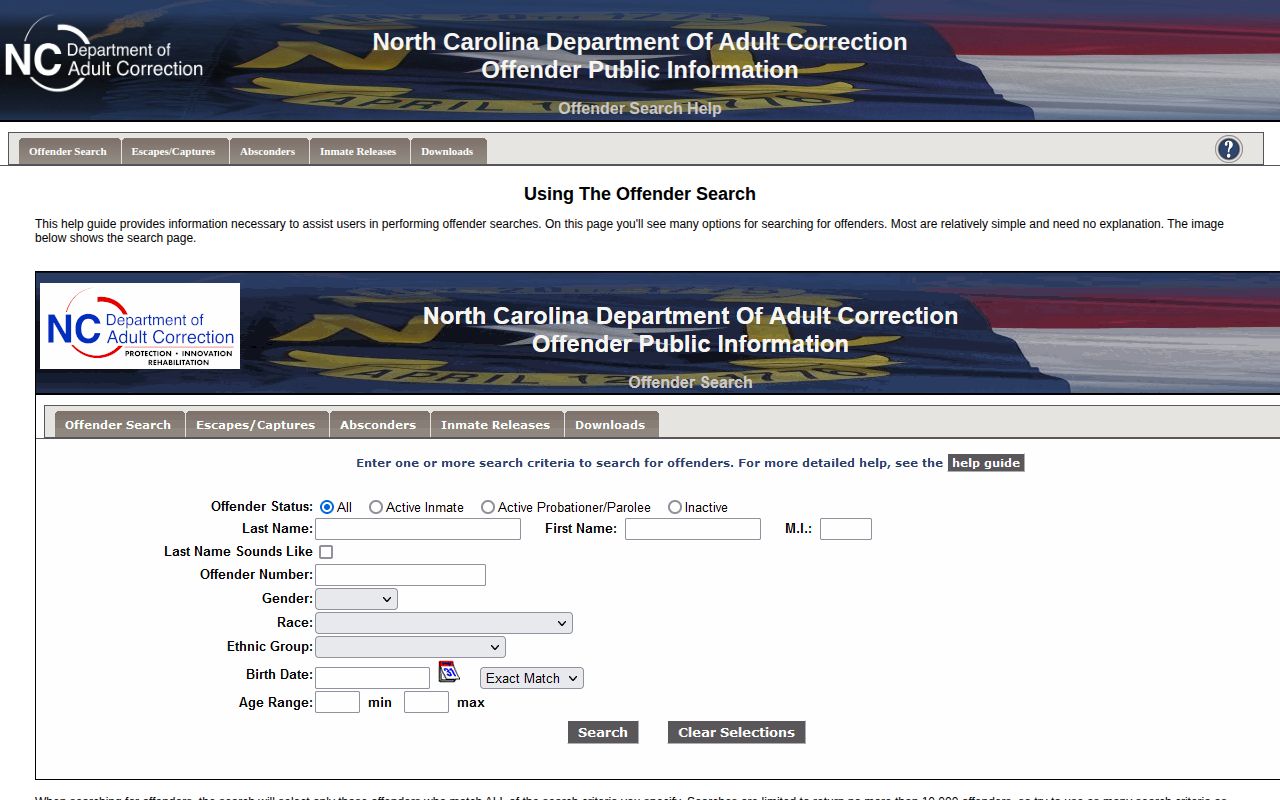
The public interface illustrates where state record fields are defined, while the correct person’s opened incarceration episode supplies the date.
North Carolina State Release Calculation
Structured Sentencing controls many modern felony cases. Under G.S. 15A-1340.13(d), the person must serve the judicial minimum. Earned time can reduce the maximum term, but never below that minimum. The Commission summarizes this structure as service of 100 percent of the minimum and at least 85 percent of the maximum for covered crimes committed on or after October 1, 1994.
That summary is not a flat 15 percent discount. The judgment’s minimum and maximum range, offense class, earned credit, prior-confinement credit, post-release structure, and later orders control the state display. Estimating by multiplying the sentence by 85 percent can produce the wrong date.
DAC’s earned-time and release-date explanation supplies the official context for the computation.
The DAC explanation connects the estimate to credits that may be earned, lost, or recalculated during confinement.
Older Fair Sentencing cases require a different analysis. DAC describes good time of one day for each day of good behavior, subject to loss for discipline, plus possible merit time. Traditional parole may remain relevant. A post-1994 formula must not be imposed on an older eligible sentence.
Burke Release Date and Supervision
Physical prison release is not always sentence discharge. G.S. 15A-1368.2 sets structured release to post-release supervision at the maximum less specified supervision periods and earned time. The statute uses 12 months for B1 through E felonies, nine months for F through I felonies, and a specified 60-month structure for certain reportable sex-offense maximums.
A person at this point is outside prison but remains in the supervised phase of the sentence. OPI should be read in two places: the incarceration episode for Projected or Actual Release Date, then probation, parole, or PRS status for ongoing community supervision. A projected state date can therefore mark transition from prison to supervision, not the end of all correctional authority.
The Commission’s parole-process summary helps distinguish modern structured release from traditional discretionary parole. Eligible older-law cases can depend on a Commission decision. A review, investigation, denial, or grant can affect an earlier conditional date, but a grant should be verified in OPI after it takes effect.
Burke Jail Release Credit Rules
Burke County jail credit is the page’s key local calculation. It is not the state “85 percent” shorthand. Start with the criminal judgment and qualifying prior-confinement credit under Article 19A of Chapter 15. Then ask the Burke County Jail for its current calculation. The jail custodian, not a public arithmetic shortcut, determines qualifying work and program participation.
G.S. 162-60 allows four days of sentence reduction for each 30 days of faithful assigned work. It provides the same structure for specified education, rehabilitation, or training participation by qualifying locally housed misdemeanor prisoners. Escape or attempted escape can forfeit that reduction.
The statute page below shows the source for this Burke County projected release-date rule.
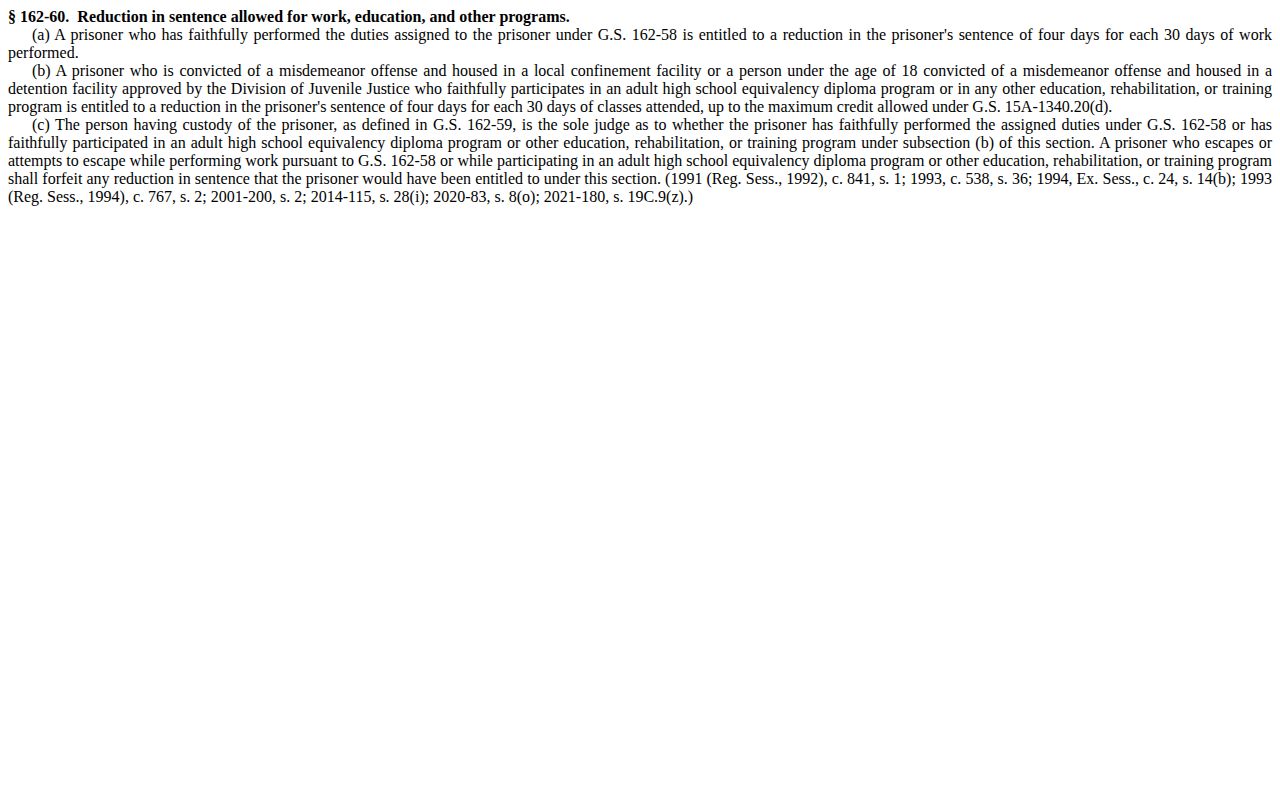
The statutory rule is only one input. G.S. 15A-1340.20(d) caps the combined authorized misdemeanor earned credit at four days per month. Participation must qualify and remain faithful. Do not subtract 15 percent from a local jail term.
What Changes Burke Release Dates
A projected date can move earlier, later, or disappear when the legal or custody record changes. The reason must be tied to the correct episode rather than guessed from a new screen value.
| Factor | Effect on the release date |
|---|---|
| Work or program participation | May earn credit while qualifying participation continues |
| Discipline or credit loss | Can move a projected date later |
| Prior-confinement correction | Can change the credited start or endpoint |
| Vacatur or resentencing | Can alter or eliminate the controlling judgment |
| Parole decision | May grant or deny earlier conditional release in an eligible older case |
| Transfer | Changes location or calculating authority but is not release |
| Detainer or other sentence | May prevent community release after one term ends |
| Death | Ends custody but is not a community release |
A federal, immigration, county, or state hold can make a date appear to have arrived while confinement continues elsewhere. Court orders and agency records are needed to explain that result. State victim-notification materials say calculations should account for earned and disciplinary credits and be as exact as possible, but they do not guarantee a public estimate will never change.
Burke County and State Sources
Use the source that owns the custody record. Burke County Jail handles local booking and release data. NC DAC handles state incarceration and supervision. The Burke clerk keeps the judgment and later orders. VINELink reports agency-supplied custody events. These sources can agree while describing different stages.
| Custody situation | Best release-date source | Key caution |
|---|---|---|
| Pretrial at Burke County Jail | Jail status plus court bond or release order | No fixed sentenced date |
| Local jail sentence | Jail calculation and court judgment | Local credit rules apply |
| State prisoner | NC DAC OPI incarceration episode | Projected differs from Actual |
| Released to PRS or parole | OPI release and supervision fields | Outside prison, not discharged |
| Federal or ICE custody | Responsible federal locator or agency | Not covered by Burke or DAC date fields |
The county current-inmate catalog is useful for present custody, but absence does not prove release. A person may have transferred. The full Burke County release-record path connects the jail record, court case, and other custody systems.
Burke Court and Credit Records
The judgment supplies the legal sentence that every release calculation starts from. North Carolina prior-confinement law then credits qualifying time already spent in custody against the minimum and maximum terms, subject to statutory exclusions. A corrected credit entry can move the endpoint even when the original sentence length does not change. For a Burke case, the clerk’s file is the source for the judgment, later modification, vacatur, or resentencing order.
The Burke County Courthouse is at 201 South Green Street in Morganton. Its public terminal and paper file can be used to find the matching criminal case. Search with the defendant name or case number, then identify the active judgment and any later order. The clerk’s posted main number is 828-433-3200, with posted weekday hours from 8:30 a.m. to 5 p.m. Confirm hours before travel.
A court order and a custody record answer related but different questions. The judgment establishes the sentence and credits the court awarded. The jail or DAC applies the governing custody and earned-credit rules to produce the operational date. The court file may therefore explain why a date changed without recording the precise time a person left a facility.
Request a recalculation explanation from the agency that holds the person when the displayed date conflicts with the judgment. Supply the offender or booking number, case number, sentence date, and the specific incarceration episode. Do not combine dates from two sentences or assume that a credit shown in one case applies to another.
Confirm Burke Release Date Events
A pending date can be monitored through NC SAVAN, also called VINELink. The service receives participating county-jail and state corrections events. It can report release, transfer, escape, capture, or another custody change, depending on the record and registration. Separate county and state offender identifiers may require separate registrations.
The Burke VINELink release check explains identity matching and phone, text, or email alerts. A notification remains an agency-status event. It does not prove final sentence discharge, the absence of another hold, or the exact fields in a historical release form.
After the expected date, return to the owning record. For a state prisoner, look for Actual Release Date on the correct incarceration episode and read supervision status. For the county jail, request booking number, admission date and time, release date and time, disposition or reason, releasing authority, and transfer destination when public. The Sheriff record is the durable source when the live roster no longer displays the person.
Keep a dated copy of the matching result and note the source. A later screen may reflect recalculation, transfer, or a completed event.
Note: Confirm the completed event with the agency that held the person, even when the projected date and notification agree.